Aion Culinary

• Meal, Myth & Musing • Anthropologist and chef passionate about the stories we eat and the cultures that nourish us • ⁠Current projects: Thermopolium, PARADOXVM, Jām-e Jān


  • Not all time is the same.


    There is a kind of time that can be measured, that moves forward, that accumulates.
    And there is another that interrupts.


    In Greek philosophy, Kairós represents this second kind of time: the precise moment, the decisive instant when something must happen. It is not about quantity, but about quality. It is not the time that passes, but the time that matters.


    Unlike Cronos — the linear time that organizes life into seconds, minutes, and hours — Kairós is time experienced through intensity. It is that exact point when conditions align and action finds its meaning.


    It cannot be fully planned.


    It cannot be repeated.


    It can only be recognized… and seized.


    In artistic tradition, Kairós is depicted as a young man with wings on his feet, always in motion, always on the verge of escaping. His image embodies the speed and fragility of the opportune moment.


    But there is an even more revealing detail.


    Kairós has a lock of hair only at the front of his head. The metaphor is clear: he can only be grasped as he approaches. Once he has passed, there is nothing left to hold.


    The missed moment does not return.


    Kairós is not constant time.


    It is an event.


    It appears in specific moments:


    in a decision that alters the course of a life,
    in a conversation that arrives at exactly the right time,
    in a gesture that transforms the ordinary into something meaningful.


    It is the instant when something “clicks.”


    Within the context of Meal, Myth & Musing, Kairós opens a different dimension of time.


    If Cronos pushes us forward,
    and Aion reminds us of the eternal cycle,
    Kairós invites us to be present.


    To recognize.


    To act.


    To feel when the moment is right.


    In the kitchen, Kairós is everywhere.


    In the exact point of doneness.


    In the moment an ingredient reveals its best expression.


    In the precise instant a dish must be served.


    One second too early, it is not ready.


    One second too late, something is already lost.


    But it also lives beyond it.


    In the pause before speaking.


    In the gaze that holds a connection.


    In the moment we choose to sit, to share, and to truly be present.
    Perhaps life is not about controlling time,
    but about learning to recognize these moments.


    Not letting them pass.


    Because Kairós does not wait.


    It does not insist.


    It does not repeat itself.


    It appears…
    and disappears.

  • There was a time when time itself had a body.

    In Greek mythology, Cronos, the youngest of the Titans, was born from Gaia — the Earth — and Uranus — the Sky. His story begins with rupture. Urged by his mother, Cronos takes a sickle and overthrows his father, severing the primordial order and establishing himself as ruler of the cosmos.

    Under his reign, the world enters what is often remembered as the Golden Age — a time of abundance, harmony, and effortless existence. There were no laws, because there was no need for them. No conflict, no ambition, no excess. Humanity lived in quiet alignment with the natural order.

    And yet, within this apparent perfection, a fracture already existed.

    A prophecy reaches Cronos: just as he overthrew his father, one of his own children will one day overthrow him. Time, it seems, cannot escape itself.

    What follows is one of the most unsettling images in mythology.

    Cronos begins to devour his children at birth.Each act is an attempt to stop what cannot be stopped.Each act is fear made visible.

    But time, by its very nature, moves forward.

    Rhea, his companion, refuses to accept this cycle of destruction. She hides their youngest son, Zeus, in a cave, preserving the possibility of change. Years later, Zeus returns — not only as a son, but as a force of transformation. He confronts Cronos, defeats him, and releases his siblings from within him, restoring what had been consumed.

    With this, a new order begins: the reign of the Olympian gods.

    Cronos is often understood as the embodiment of linear time — time that advances, that consumes, that cannot be reversed. Unlike cyclical time, which returns and renews, Cronos moves in one direction only: forward, carrying everything with it.

    He is the time we measure.

    The time we fear losing.

    The time that devours all things.

    And yet, his myth is not only about destruction.It is about the tension between control and inevitability.

    Between holding on and letting go.

    Between the desire to preserve and the necessity of transformation.

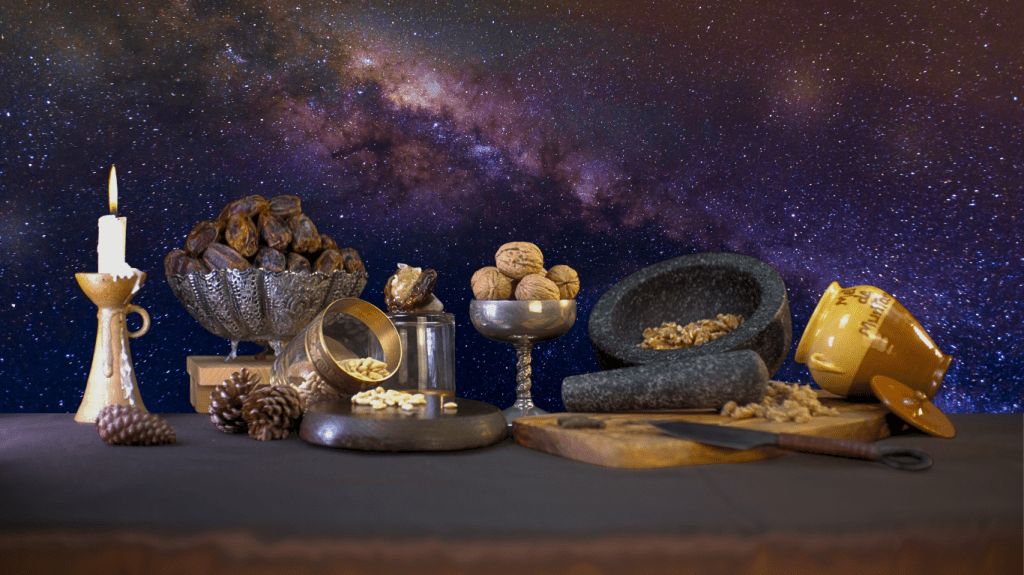
  • In the ancient world, time was not a straight line —it was a cycle, endlessly unfolding into itself.

    Aion is the embodiment of that eternal time.Neither born, nor dying — only existing.

    Beyond seasons, beyond measure, beyond urgency,Aion represents a continuity that sustains everything.He is both the old and the young.

    The beginning and the return.The stillness and the transformation.

    Aion lives in the rhythm of change —in fire, in matter, in the unseen passage from one state to another.He is present in the act of creation.In the moment of sharing.

    In what lingers after.Like the phoenix, time does not end —it transforms.

    An Experience Beyond TimeThis is not only something to understand.It is something to feel.

    To step into Aion is to slow down.

    To reconnect with the essence of time through the senses.

    Each element is intentional.

    Each moment, part of a cycle.Here, we do not follow time —we move with it.

    We do not simply consume —we participate.