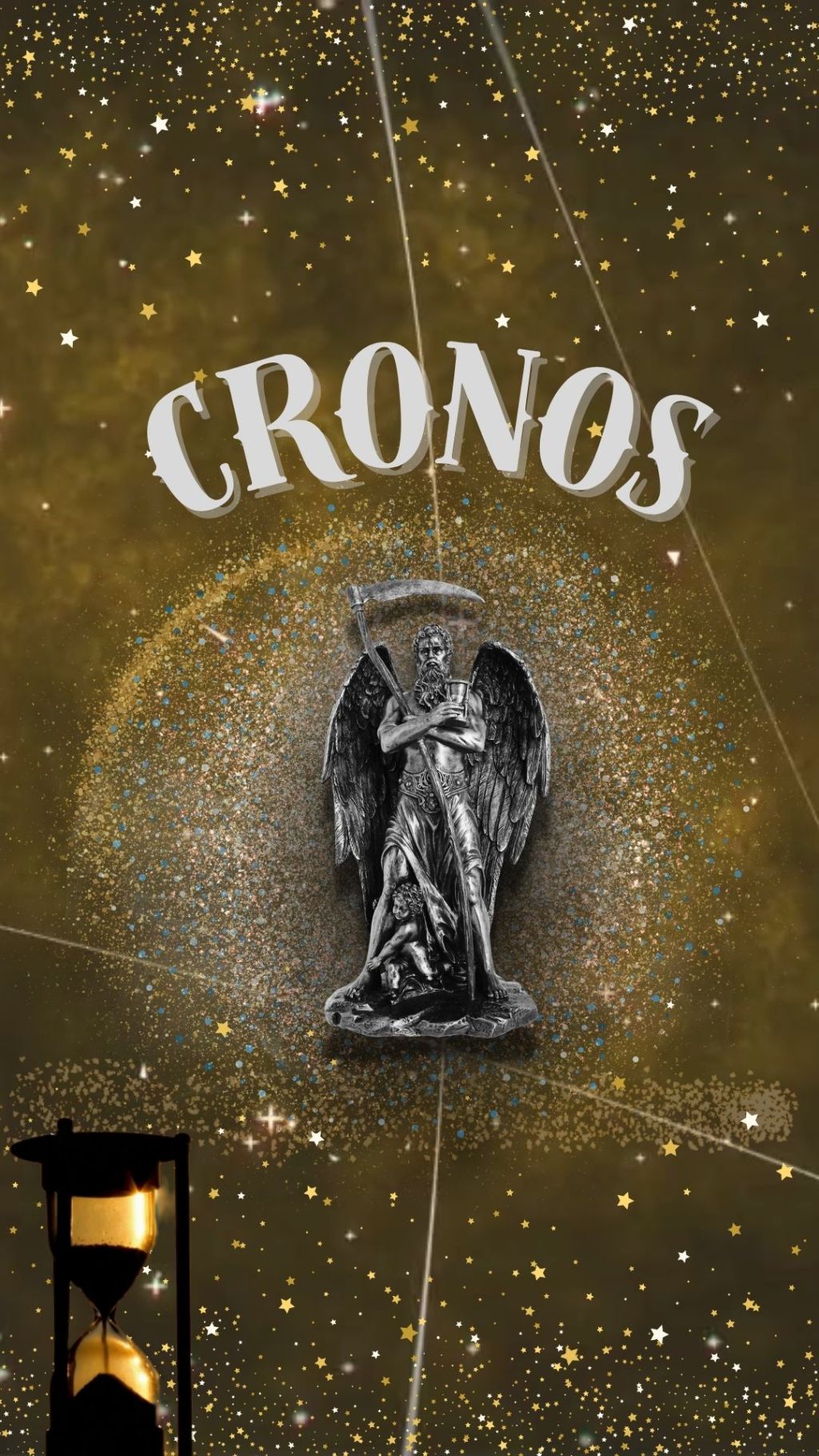
There was a time when time itself had a body.
In Greek mythology, Cronos, the youngest of the Titans, was born from Gaia — the Earth — and Uranus — the Sky. His story begins with rupture. Urged by his mother, Cronos takes a sickle and overthrows his father, severing the primordial order and establishing himself as ruler of the cosmos.
Under his reign, the world enters what is often remembered as the Golden Age — a time of abundance, harmony, and effortless existence. There were no laws, because there was no need for them. No conflict, no ambition, no excess. Humanity lived in quiet alignment with the natural order.
And yet, within this apparent perfection, a fracture already existed.
A prophecy reaches Cronos: just as he overthrew his father, one of his own children will one day overthrow him. Time, it seems, cannot escape itself.
What follows is one of the most unsettling images in mythology.
Cronos begins to devour his children at birth.Each act is an attempt to stop what cannot be stopped.Each act is fear made visible.
But time, by its very nature, moves forward.
Rhea, his companion, refuses to accept this cycle of destruction. She hides their youngest son, Zeus, in a cave, preserving the possibility of change. Years later, Zeus returns — not only as a son, but as a force of transformation. He confronts Cronos, defeats him, and releases his siblings from within him, restoring what had been consumed.
With this, a new order begins: the reign of the Olympian gods.
Cronos is often understood as the embodiment of linear time — time that advances, that consumes, that cannot be reversed. Unlike cyclical time, which returns and renews, Cronos moves in one direction only: forward, carrying everything with it.
He is the time we measure.
The time we fear losing.
The time that devours all things.
And yet, his myth is not only about destruction.It is about the tension between control and inevitability.
Between holding on and letting go.
Between the desire to preserve and the necessity of transformation.
 Aion Culinary
Leave a comment